
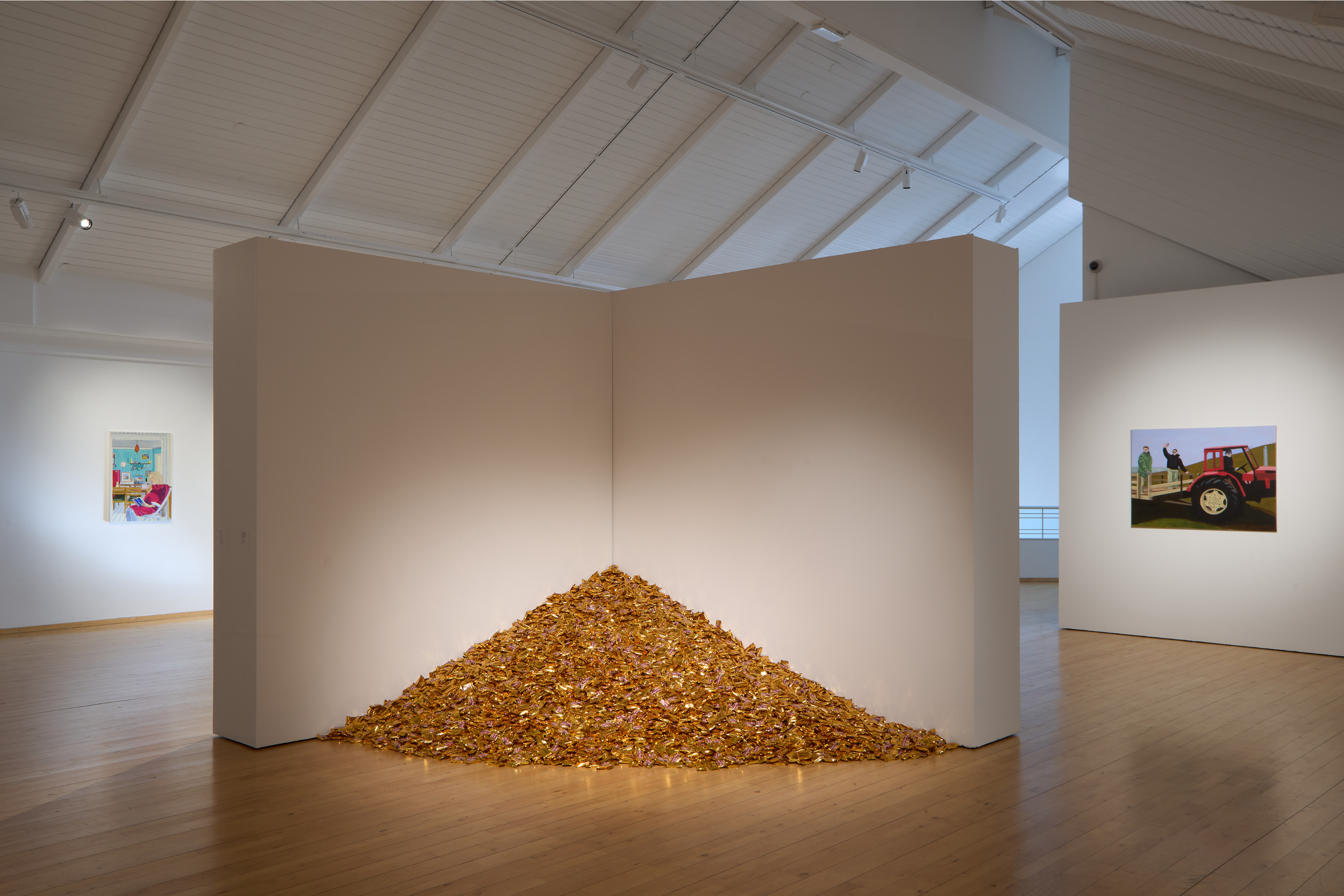
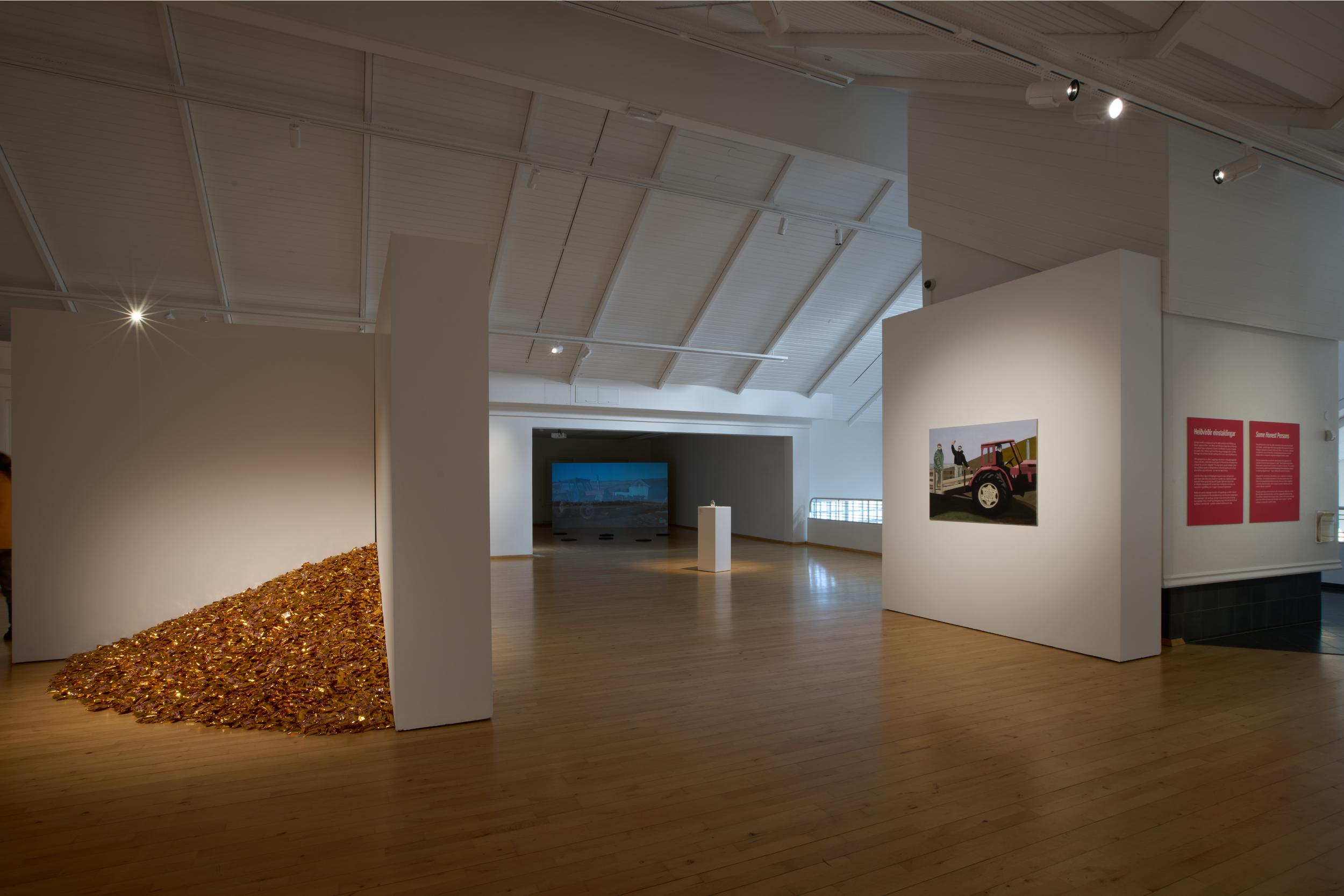
22.394, homage to Felix Gonzales-Torres, 2026, Sculpture with 22394 pieces of Prince Polo Mini, 200×200×120 cm (With Weronika Balcerak)
While researching the histories that connect Poland and Iceland, artists Lukas Bury and Weronika Balcerak came across a story that may or may not be true, of a child born in an Ursus tractor in rural Iceland and a teddy bear sent from the Ursus office in Warsaw as a gift for the newborn. The details are uncertain, but the story resonated with the artists’ own experiences – memories of family, childhood and the objects that travelled with them across borders. Like much of the exhibition, it reflects both personal history and collective movement, showing how lives, labour and care are carried forward across time and distance.
Some Honest Persons is an exhibition about how we move through the world, whether we are moving locally – driving a car, working a tractor, travelling to a job – or crossing greater distances, leaving one country and settling in another. Long before Poles became the largest immigrant group in Iceland, goods were already circulating between the two countries. Coal, textiles, machinery and consumer goods – including the now-iconic Prince Polo chocolate bar – travelled across the North Atlantic, creating a shared material culture that preceded contemporary migration by decades. Through such circulation, the things that surround us begin to feel familiar again.
It is these moments of recognition that Bury draws on in his paintings. In one scene, an Icelandic family owns the same model of car that Bury’s own relatives drove in Poland – a vehicle produced within a centrally planned economy, now reappearing in a very different social context. In another, we encounter Gunnar, the Icelandic man who once appeared in a Polish television advertisement for Prince Polo, a nod to the chocolate’s enduring popularity in Iceland. These biographical elements, combined with broader social history, show how material things carry emotional weight and link personal histories across borders.
Balcerak’s embroideries approach this history from another direction: through language, longing and small acts of reaching out. The exhibition title comes from a classified advertisement placed in 1991: “Some honest persons from Poland seeks a seasonal work in summer 91, maybe in a forestry.” Its mixture of sincerity and uncertainty speaks to a moment when the possibility of movement opened up, but knowledge of the destination remained partial. In the work Vinátta [Friendship], another advertisement becomes the basis for an appeal for connection – a Polish woman seeking a friend in a new country. These texts are modest, direct and quietly brave.
Running through the exhibition is a reflection on scale: how individual stories relate to larger social realities. Today, tens of thousands of Polish people live in Iceland. In one work, Balcerak and Bury evoke this presence through a field of Prince Polo bars numbering 22,394 – the latest available figure for the Polish population in Iceland when the artists were planning the exhibition. Echoing Felix Gonzalez-Torres, the work invites viewers to consider how value is assigned to bodies, labour and everyday forms of care within our communities.
The exhibition brings together embroidery, painting, video and archival material to trace nearly a century of entanglement between Poland and Iceland, following the stories of commercial exchanges that connect the two countries through artistic research. It shows that this relationship did not begin with recent migration, but was built gradually through trade, work and the circulation of ordinary things. In doing so, the exhibition asks a simple but urgent question: when we recognise ourselves in the lives of others – through a car, a chocolate bar, a shared story – how does that recognition shape the way we treat one another?
Like the story of the child in the tractor, the histories gathered here are carried forward not only through documents but through retelling. Uncertainty remains, yet the connections are real, reminding us that these routes are made, again and again, by people in motion. What emerges is a sense of belonging as something shifting, shaped through repetition and recognition: a car model seen in two countries, a familiar chocolate bar found in different settings, a hopeful message placed in a newspaper far from home. Some Honest Persons suggests that home is not only where we come from, but where we recognise something of ourselves – and where others recognise us in return.
Lukas Bury (b. 1991) and Weronika Balcerak (b. 1996) form the Reykjavík-based artist duo Austur-Íslendingar. The name reworks Vestur-Íslendingar, a historical term used for Icelanders who emigrated to America, and reflects questions of arrival, displacement and belonging. Their practice includes installation, textiles, image-based research and site-responsive work. They develop their projects through sustained processes of making and contextual inquiry, bringing together personal experience with historical reference. Their work is characterised by a careful use of materials and a clear spatial language, as they focus on how meaning is formed through presence, repetition and shared space.
Text: Hólmar Hólm (curator)